A sermon about being a recipient of God's gifts, enduring injustice because of them, and continuing with faith the effort to build a just world.
Matthew 14: 22-33 Rev. Dr. Galen E. Russell III
Genesis 37: 1-4, 12-28 August 9, 2026
“So, when Joseph came to his brothers, they stripped him of his robe, the long robe with sleeves that he wore; and they took him and threw him into a pit. The pit was empty; there was no water in it.”
Prayer: Most Holy God, may the truths from these stories resonate in our inner spirit. In Jesus Christ, we pray. Amen.
Previously on June 21 “The Genesis of our Faith.” In Part 1, it was the Hagar and Ishmael story. It’s a long story, but God promises in the end that a great nation will come from Ishmael’s bloodline. And of course, the origins of Islam come from his bloodline (see Genesis 21).
So basically, in Part 1, as part of the genesis, the beginnings of our faith, the message is that we see God’s care, and plans, and acceptance of people of other religions and cultures. That’s a truth we’re still learning.
In Part 2 July 19, we heard the story of Jacob’s Ladder going up to heaven and God’s divine beings going up and down the ladder.
In this story, as part of the genesis, the beginnings of our faith, we see the truth that God doesn’t love people because of who they are or what they do in life, but because of who God is. Because that’s the way God is. That’s a God truth we’re still learning, too, right? (See Gen. 25-28).
This takes us to Part 3 of “The Genesis of our Faith.” Some background info is good here, too. As a preface to our Bible reading, many years go by after Jacob saw the ladder. He eventually has a family—12 sons, 6 by Laban’s daughter Leah, 2 by Rachel, Leah’s younger sister, 2 by Zilpah, Leah’s maid, and 2 by Bilhah, Rachel’s maid. Wow! Go figure! A very different culture! And Joseph is Rachel’s firstborn son.
Now our text begins with Jacob and his family having gone back to Canaan. I’m going to read it with you, but I’ll add some commentary as I go to help us better understand the text.
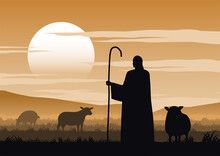
Jacob settled in the land where his father [Abraham] had lived as an alien, the land of Canaan. 2 This is the story of the family of Jacob. [Whose name, by the way, was changed to Israel because prior to this, a divine being wrestled with Jacob and told him that his name “shall be Israel, for you have striven with God and with humans and have prevailed” (see Gen. 32). The word ‘Israel’ translates as ‘wrestles with God.’] Joseph, being seventeen years old, was shepherding the flock with his brothers; he was a helper to the sons of Bilhah and Zilpah, his father’s wives; and Joseph brought a bad report of them to their father. [We don’t know what this was about but possibly started the hatred the brothers have for Joseph?]
3 Now Israel [Jacob] loved Joseph more than any other of his children, because he was the son of his old age; and he had made him a long robe with sleeves [or a coat of many colors, from the Greek version]. 4 But when his brothers saw that their father loved him more than all his brothers, they hated him and could not speak peaceably to him. A lot of human emotion there.
The text for our reading goes right on to verse 12. But verses 5-11 reveal that Joseph had a gift of truthful dreams. Prophetic visions that showed he would rule over his brothers one day. And what was worse, Joseph flaunted that vision. He was like, “In. Your. Face!” He wasn’t exactly Mr. Sensitive. He was, in short, a snot-nosed teenager! And worst of all, he was his father’s pet. So, the brothers seethed at the sight of him, especially when he pranced around, flaunting that long-sleeved, designer coat of many colors. OK, back to the text.]
12 Now his brothers went to pasture their father’s flock near Shechem. 13 And Israel said to Joseph, “Are not your brothers pasturing the flock at Shechem? Come, I will send you to them.” He answered, “Here I am.” 14 So he said to him, “Go now, see if it is well with your brothers and with the flock; and bring word back to me.” So, he sent him from the valley of Hebron.
Joseph came to Shechem, 15and a man found him wandering in the fields; the man asked him, “What are you seeking?” 16 “I am seeking my brothers,” he said; “tell me, please, where they are pasturing the flock.” 17 The man said, “They have gone away, for I heard them say, ‘Let us go to Dothan.’” So Joseph went after his brothers and found them at Dothan. 18 They saw him from a distance, and before he came near to them, they conspired to kill him. 19They said to one another, “Here comes this dreamer. 20 Come now, let us kill him and throw him into one of the pits; then we shall say that a wild animal has devoured him, and we shall see what will become of his dreams.” [Hah!]
21 But when Reuben heard it, he delivered [Joseph] out of their hands, saying, “Let us not take his life.” 22 Reuben said to them; “Throw him into this pit here in the wilderness but lay no hand on him” [Whisper]—that he might rescue him out of their hand and restore him to his father. [Ah, Reuben! He’s the oldest brother, and maybe he has at least a twinge of conscience here. He secretly planned to come back and get Joseph out of that pit.]
23 So when Joseph came to his brothers, they stripped him of his robe, the long robe with sleeves that he wore; 24 and they took him and threw him into a pit. The pit was empty; there was no water in it. 25 Then they sat down to eat. [And I was like, what? They sat down to eat just like that? As if nothing happened? Talk about pretending! And covering up guilt! Sheesh!]
And looking up they saw a caravan of Ishmaelites coming from Gilead, [Ah, here come Hagar and Ishmael’s descendants!] with their camels carrying gum, balm, and resin, on their way to carry it down to Egypt. 26Then Judah [perhaps also with a twinge of conscience] said to his brothers, “What profit is it if we kill our brother and conceal his blood? 27Come, let us sell him to the Ishmaelites, and not lay our hands on him, for he is our brother, our own flesh.” And his brothers agreed.
[At this point, the brothers leave to tell their father Jacob that his favorite son was killed by a wild animal. And they had the blood-soaked, torn coat to prove it. However, unknown to them…]
28When some Midianite traders passed by, they drew Joseph up, lifting him out of the pit, and sold him to the Ishmaelites for twenty pieces of silver. And they took Joseph to Egypt.
What a story! There’s so much in it about human nature. About emotions and struggle. About violence and lies.
But for today, I wanted to focus on the long-sleeved robe, that coat of many colors. Jacob gave Joseph that coat because Jacob favored Joseph. And using an interpretive lens, I invite us to see how that colorful coat can represent how much God favors each of us, how beloved we are, and the many colorful gifts that God gives each of us.
Of course, the one gift Joseph had was the gift of prophetic dreams and visions. Today I invite you to think about the gifts God has given you.
And so, this is an interactive exercise in my sermon. Your bulletin insert has a coat of many colors for you. Take a moment now and think of the gifts you have—could be the gift of dreams, or the gift of music, or writing, or the gift of numbers, or using your hands, or the ability to lead people, or to organize space, or understand human nature, etc. Whatever your gifts are, write them in the spaces of your choice on your coat of many colors.
Next, I invite you to consider your God-given qualities, or your authentic characteristics as a human being… could be your physical features, your personality or orientation, your lifestyle or political persuasions etc., and write some of those in the spaces on your coat of many colors.
Now, look at your coat of many colors. These gifts and authentic characteristics are just a small portion of who you are. But ask yourself, which of these on your coat have gotten you into difficulty? Which were you ridiculed for? Or were bullied because of who you are? Or treated unjustly? Which drew the ire of others because you had a particular gift or quality? Circle any of these, if you desire.
The point I want to make is that yes; God is a God who favors all by gifting us with love and encouraging grace toward others. God transcends and challenges human jealousy, competitiveness, resentments, and yes even human snootiness and encourages people to honor God’s image in one another.
You’re beloved in God’s sight no matter who you are. God favors you. God loves your authentic self—your brand of your coat of many colors.
But this ancient Joseph story coming from the beginnings of our faith heritage also emphasizes, I think, that God is a God of justice. God’s sense of care for the beaten, the outcast, those betrayed and subjected to violence and exclusion is magnified. Like Joseph in the pit.
The good news is that we can hear, if we listen, Jesus saying to us in the pit, or when we’re sinking in the storms, like Peter, “Take courage! It is I!” These words are our hope!
To those in the pit of war and ineffective ceasefires, hear the words “Take courage! It is I!”
Those in the pit of unjust laws for marginalized citizens, or the pit of citizens not being able to vote because of unfair gerrymandering or unjust voting laws, “Take courage! It is I!” These are the ones whose voices cry out to God’s ears. These are the ones whose perspectives, hopes, and thoughtful dissent need God’s justice.
To the ones who are sinking into the raging sea of homophobia, “Take courage! It is I!”, says Jesus. Or the ones who are drowning by those stoking the fires of Islamophobia and antisemitism, by promoting conspiracy theories about Muslim Americans and Jewish Americans, “Take courage! It is I!”, says Jesus. To the ones who dream of a different world, a just world, a world of peace, and understanding, and communication, and care., “Take courage! It is I!”, says Jesus.
The good news, I believe is that God’s reign in our lives transcends human systems of oppression and exploitation. Working for justice falters when fear becomes greater than hope. But as soon